
Services
Retrofit Assessments
Whole House Retrofit Assessments Tailored to Your Property
A Retrofit Assessment is the essential first step in any home improvement project. Before any measures are installed or changes are made, it is important to understand how your property currently performs and which improvements will have the greatest impact. At BSM Energy, our qualified Retrofit Assessors carry out a comprehensive whole house survey, providing a clear and accurate view of your home’s energy performance along with a structured plan for improvement.
What It Involves:
Our Retrofit Assessors visit your property and conduct a detailed evaluation of all key elements of the building fabric and systems. This includes assessing insulation levels across the roof, walls and floors, reviewing the heating system, hot water provision and controls, evaluating ventilation arrangements and air quality, and examining windows, doors and other features that influence thermal performance.
All findings are recorded and analysed in accordance with PAS 2035, the recognised standard for whole house retrofit in the UK. The outcome is a tailored Retrofit Improvement Plan that outlines the recommended measures, the order in which they should be carried out, and the reasoning behind them, ensuring each improvement works effectively with the overall performance of your home.

Why It Matters:
Carrying out retrofit measures without a proper assessment can lead to significant issues, from damp and condensation caused by poorly sequenced improvements to oversized heating systems that result in unnecessary energy use and increased costs. A PAS 2035 compliant Retrofit Assessment helps protect against these risks by ensuring that every decision is evidence based, properly documented and tailored to the specific characteristics of your property.
- Homeowners looking to improve comfort and reduce energy bills
- Private landlords needing to meet EPC requirements
- Social housing providers planning retrofit programmes
- Developers seeking compliance with current energy standards
Retrofit Coordination
Expert Retrofit Coordination from Initial Planning to Final Sign Off
Retrofit coordination is central to the success of any retrofit project. Without expert oversight, even well planned improvements can be delivered in the wrong sequence, by unsuitable contractors or without the necessary compliance checks, leading to costly errors, failed inspections and poor results. BSM Energy’s Retrofit Coordinators provide professional management throughout the entire process, from initial design through to final sign off.
What It Involves:
Once a Retrofit Assessment has been completed and an Improvement Plan is in place, our Retrofit Coordinator manages the full delivery process. This begins with reviewing and approving the technical design of each proposed measure, ensuring it is suitable for your property and aligned with other planned improvements.
Our coordinator then oversees the selection of TrustMark accredited installers, manages the scheduling and sequencing of works, and carries out quality assurance checks throughout the installation process. At every stage, we ensure that all work aligns with the approved design and that all required documentation is completed accurately and on time.
Upon completion, the Retrofit Coordinator conducts a comprehensive final review to confirm that all measures have been installed correctly and that the project meets PAS 2035 requirements. Only once this has been verified is the project formally signed off, providing complete confidence in the final outcome.

Why It Matters:
PAS 2035 requires that all funded or registered retrofit projects are overseen by a qualified Retrofit Coordinator. This is not simply a regulatory formality it is a genuine safeguard for you as a homeowner or landlord. The Retrofit Coordinator acts as your independent quality assurance, ensuring that installers meet the required standard and that your home is improved correctly, safely, and sustainably.
- Homeowners undergoing multi-measure retrofit projects
- Landlords managing improvement works across one or more properties
- Local authorities and housing associations commissioning retrofit programmes
- Any project requiring PAS 2035 compliance and formal sign-off
Retrofit Installation
High-Quality Retrofit Installation, Delivered to the Highest Standard
A retrofit project is only as good as the quality of its installation. At BSM Energy, our TrustMark-accredited installation teams carry out every improvement measure with precision, care, and a commitment to quality that sets us apart. Whether you need insulation, heating upgrades, ventilation improvements, or a combination of measures, we deliver the full installation — minimising disruption to your home and ensuring every element performs as intended.
What It Involves:
BSM Energy installs the full range of retrofit improvement measures, including but not limited to cavity wall insulation, loft and roof insulation, solid wall insulation (internal and external), underfloor insulation, upgraded heating systems and controls, mechanical ventilation with heat recovery (MVHR), and other energy efficiency measures identified in your Retrofit Improvement Plan.
Every installation is carried out by qualified, TrustMark-accredited tradespeople who have been vetted and approved to work on PAS 2035-compliant retrofit projects. Our teams follow the approved technical design at every stage, working to the schedule agreed with your Retrofit Coordinator and maintaining open communication with you throughout.
We take care to protect your home during works, keeping disruption to a minimum and leaving your property clean and tidy on completion. Before we leave, a thorough post-installation check is carried out to confirm that every measure has been installed correctly and is performing as expected.

Why It Matters:
Poor installation is one of the most common causes of retrofit failure. Insulation installed without proper attention to continuity and detailing can leave cold bridges. Heating systems sized without accurate heat loss calculations can underperform or waste energy. At BSM Energy, our installations are always carried out in line with the approved retrofit design giving you confidence that your home has been genuinely improved, not just superficially treated.
- Homeowners whose Retrofit Assessment and Coordination is complete and ready for installation
- Landlords requiring compliant improvement works across residential properties
- Any property owner seeking TrustMark-accredited, PAS 2035-compliant installation
Energy Performance Certificates
Fast, Accurate Energy Performance Certificates — Lodged Within 24 Hours
An Energy Performance Certificate (EPC) is one of the most important documents associated with any residential property in the UK. Whether you are selling, letting, or improving your home, a valid and accurate EPC is a legal requirement and a vital tool for understanding your property's energy performance. BSM Energy's Elmhurst Energy-accredited assessors provide professional EPC assessments across the UK, delivering lodged certificates within 24 hours.
What It Involves:
Our accredited energy assessors visit your property and carry out a thorough inspection, gathering data on the construction, insulation, heating system, hot water provision, lighting, and other energy-related features of your home. This information is entered into government-approved software to calculate your property's current energy rating expressed as a score between 1 and 100 and the rating it could achieve if recommended improvements were carried out.
The resulting EPC is a standardised document that rates your property on a scale from A (most efficient) to G (least efficient), includes an estimated energy cost, and provides a list of recommended improvements with indicative costs and savings. Once produced, your EPC is officially lodged on the national register, making it immediately available for legal and compliance purposes.

Why It Matters:
A valid EPC is a legal requirement when selling or renting a property in the UK. Private landlords must ensure their properties meet a minimum EPC rating of E under the Minimum Energy Efficiency Standards , with stricter requirements expected in the coming years. For homeowners undertaking retrofit works, an EPC also provides an essential baseline documenting your property's current performance and enabling you to measure the improvement achieved after works are completed.
- Homeowners preparing to sell their property
- Private landlords ensuring rental compliance under MEES
- Property developers seeking EPC ratings for new or renovated homes
- Homeowners establishing a baseline before retrofit works
Airtightness Testing
Certified Airtightness Testing — Precise Results, Full Compliance
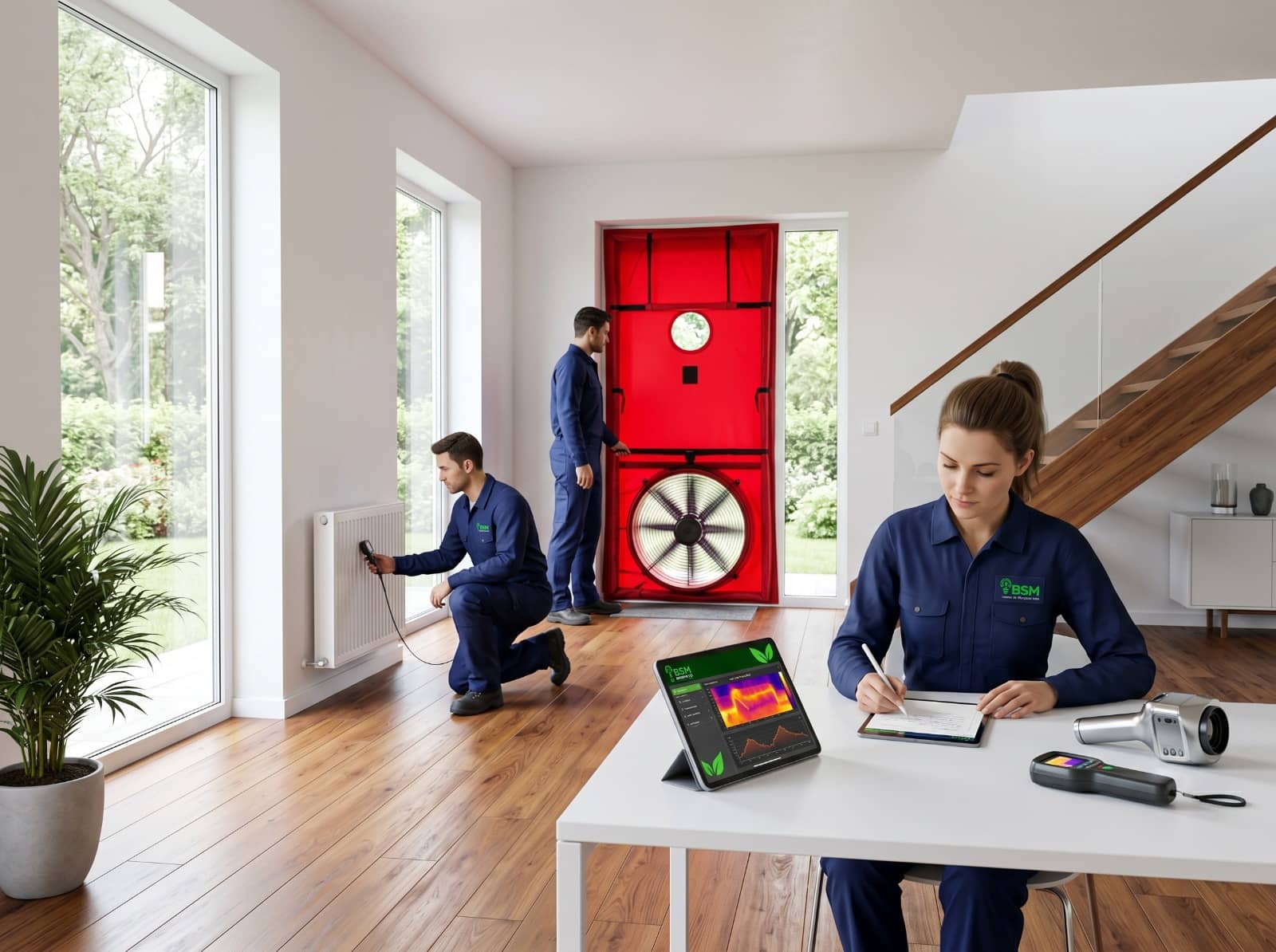
Airtightness is one of the most significant — and most frequently overlooked — factors in a property's energy performance. Uncontrolled air leakage accounts for a substantial proportion of heat loss in UK homes, driving up energy bills and reducing comfort. BSM Energy's certified testers use professional blower door equipment to accurately measure the airtightness of your property, providing the data you need to meet regulatory requirements, support retrofit design, and achieve meaningful improvements in thermal performance.
What It Involves:
An airtightness test — also known as an air pressure test or blower door test — is carried out by temporarily sealing the external openings of your property and using a calibrated fan to pressurise or depressurise the building. By measuring the rate at which air flows through the building fabric at a standardised pressure difference, we can accurately quantify the level of air leakage.
The result is expressed as an air permeability value — the volume of air passing through each square metre of the building envelope per hour at a pressure of 50 Pascals (m³/h.m² @50Pa). This figure is used to assess compliance with Part L of the Building Regulations, to inform the design of ventilation systems within a retrofit project, and to benchmark the improvement in airtightness achieved after draught-proofing or other fabric measures have been installed.
Our testers provide a clear, detailed report following every test, setting out the results, their implications, and any recommendations for improvement.
Why It Matters:
For new build properties, airtightness testing is a mandatory requirement under Part L of the Building Regulations. For retrofit projects, airtightness testing plays a critical role in ensuring that improvements to the building fabric are working as intended — and that ventilation provision is correctly matched to the level of airtightness achieved, protecting against damp, condensation, and poor indoor air quality.
- Homeowners and landlords undergoing whole-house retrofit works
- Developers seeking Building Regulations compliance for new builds
- Retrofit Coordinators requiring airtightness data to inform system design
- Property owners wishing to identify and address draughts and air leakage
Factor Temperature Calculations
Accurate Factor Temperature Calculations for Correctly Specified Heating Systems
Getting the heating system right is one of the most important outcomes of any retrofit project. An undersized system will struggle to heat your home adequately; an oversized system will waste energy and increase your running costs. Factor Temperature Calculations also known as heat loss calculations are the technical foundation on which accurate heating system design is built. At BSM Energy, our qualified assessors produce detailed, PAS 2035-compliant Factor Temperature Calculations that ensure your heating measures are precisely matched to your property's specific needs.
What It Involves:
Factor Temperature Calculations involve a detailed analysis of your property's heat loss characteristics taking into account the size, construction, and insulation levels of every element of the building fabric, including walls, floors, roof, windows, and doors. The calculations also account for the thermal bridging at junctions between elements, ventilation heat loss, and the internal and external design temperatures relevant to your location.
The result is an accurate figure for the total heat loss of your property expressed in watts which is used to correctly specify the output required from your heating system. This ensures that your boiler, heat pump, or other heat source is sized to meet your property's actual demand, delivering comfort and efficiency without waste.
Our assessors use approved calculation methodologies in line with the requirements of PAS 2035 and the Domestic Heating Compliance Guide, producing fully documented outputs that can be shared with installers, Retrofit Coordinators, and building control as required.

Why It Matters:
Without accurate heat loss calculations, heating systems are frequently oversized a common problem in UK homes that leads to short cycling, reduced efficiency, increased wear, and higher running costs. In a retrofit context, this issue is compounded by the fact that improvement measures change the heat loss characteristics of your property meaning that a heating system specified before retrofit works are carried out may be entirely inappropriate afterwards. BSM Energy's Factor Temperature Calculations are always based on your property's post-retrofit condition, ensuring your heating system is specified for the home it will actually be heating.
- Retrofit Coordinators requiring heat loss data to inform heating system design
- Homeowners planning to install or replace a heating system as part of a retrofit
- Installers needing documented calculations to support system specification
- Any project requiring PAS 2035-compliant heating system design evidence